Sunday, April 12, 2015

Ready, Set, GLOW!

Last week I had the pleasure of attending Camp GLOW (Girls Leading Our World).  Camp GLOW is done in many Peace Corps countries worldwide and we are just starting to introduce the idea to Nepal.  The camp is typically 5-7 days and each day has a different theme.  Some themes include empowerment, health, gender equality, development, sexual education, and leadership.  It was organized by a group of 5 volunteers from Dang who hired educators from a women’s rehabilitation center (WOREC).  The week consisted of different activities focusing on the day’s theme.  Both the Peace Corps volunteers and women from the WOREC group did activities and presentations.

I was lucky enough to go as a 3TOT participant which meant that I got to attend, learn, and help out with the intention of later doing this camp in my district.  I believe girls in the Far West where I live would particularly benefit from the camp beause of the added challenes they face with menstruation rules.  It is a practice that is fairly unique to the Far West to have young women live in isolation for the 7 days during their menstruation.  I wrote about this in a previous blog and have experienced it to a lesser degree myself at site.

Although I love living at my site with my family, being at the camp for a week reminded me of going to Girl Scout camp when I was little.  How lucky I was to spend a week doing crafts, dancing, playing games and watching movies.  Girls in Nepal don’t get opportunities like this often.  The idea of “camp” is foreign to Nepali’s who rarely travel outside their village.  All the kids under 20 in my family usually only leave the village to visit relatives, or go to the doctor.  Fun outings are a rare opportunity as there is so much work to be done around the farm tending to the animals, working in the fields, and cooking food.  It was great to see them meeting new friends, having fun and learning some really important information.

Some of the topics involved psychosocial health, while others were more informative.  I was surprised to hear that during the anatomy class many of the girls were aware of the terms being taught.  Some of the information was new to them, but they knew many of the basics.  However, it became apparent that the sexual health eduation most Nepali’s receive was somewhat lacking in other atreas.  During the sexually transmitted disease presentation one of the Nepali lady presenters shared a story about how when she was younger her sex ed teacher demonstrated how to use a condom by putting it on her finger.  Feeling confident with her knowledge about how to avoid getting pregnant, she proceded accordingly with her husband.  Much to her suprise, she became pregnant.  She went to the doctor and asked how it was possible that she got pregnant as she was using condoms.  The doctor asked how she was using it and she responded that she was putting it on her finger like she was shown in class.  It’s stories like this that make me realize how important it is to be thorough when doing trainings.

Although I was there mostly to help behind the scenes and learn, I volunteered to lead small energizer activities and teach yoga class in the mornings.  Every morning (except one day that I was sick) I lead a class of 5-10 girls and women in yoga.  Many of the girls knew what yoga was, but they didn’t know how to practice it.  It was fun to teach the class because if I didn’t know exactly how to describe what I was doing in Nepali, I could always say “do it like this!”  I was touched by the enthusiasm for the class.  One dedicated student was around 60 years old.  I was afraid that the class might be too athletic for her, but after the class she explained that yes, her body hurt a little, but it was a good kind of hurt.  The day I was sick she asked my friend why there was no class and said that she didn’t feel so good that day because she didn’t get to do yoga in the morning.  The next day I taught class again and she was all smiles.

One interesting observation that my friends had of the group was the lack of individual thinking among the girls.  In school, there is very little creative thinking, self expression, and critical thinking.  Most of the Nepali and English classes involve reciting from books and memorizing.  For example, my 14 year old brother can read pretty fast in English;  but after he reads a paragraph and I ask him if he understood what he read, he doesn’t know.  He also isn’t able to form his own sentances in English.  Independent, creative thinking is not encouraged and it was evident in some of the art projects.  One project we did involved making a “dream board” in which the girls cut out pictures in magazines of all the things they wanted to see, and have in their life.  My friend did a dream board for herself as a demonstration.  It included eating healthy food, visiting different countries, and growing up to be an old, spunky lady.  Some of the girls were original in their dreams, but many followed the demonstration board almost exactly.  Perhaps the girls didn’t understand the project very well, but in general it seemed hard for them to think independently of eachother.  Despite this, one activity that did bring out the girls individuality was the papermache mask making activity.  My friend was estatic that each mask looked different and unique.  

On the last day of camp we had a bonfire and roasted marshmallows.  The girls, chaperones, and staff all enjoyed the marshmallows that we sandwiched between two cookies as we couldn’t find chocolate bars or grahm crackers.  I then experimented with an activity that was similar to one I have taught in the states during a yoga class.  During the class we did lots of shaking, chanting mantras, and dancing.  I named the class “Kali” yoga after the Hindu goddess of destruction and change.  After developing a strong, communal energy I had the girls go into the circle one at a time and shout to the universe something they wanted to see manifest in their life.  Some of the demands were career related…one wanted to be a doctor, another a policewoman.  While others were more life goal based…wanting to learn English, or wanting to go to America.  After the America comment I told them that Nepal is great too!  I also told the girls to remember that their body and their life belongs to them.  Although there may be rules in life that they must follow, that doesn’t change who they are.  It is their right to make their own choices and be who they want to be.  I had the conversation translated into Nepali by a friend.  After reading my little speech the girls applauded.  


Since coming to Nepal, I have not had a chance to work much with Nepali youth.  The older I get, the less I seem to feel I can relate to them.  However, after this GLOW camp I realized how easy it was, and how meaningful it can be.  I will always look back on it with a smile and hopefully someday, with the help of other PC volunteers, make one of our own.


Christine leading a human knot energizer

Girls drawing pictures of what they like about themselves during a self confidence activity

The girls weren't the only empowered ones during the camp!  This is Peace Corps Volunteer Shayne's empowered drawing of himself.

Lot of giggles during the condom/sex education talk

The best way to wake up a group of Nepali's?  Dancing!

Lymbo!  Oh ya...we went there

Maria being awesome with her didi (older sister) during the dance party

Shayne and Ben being ballers...of yarn for friendship bracelets of course!

Shayne demonstrating how to cook the perfect mallow

Maria's mask melody

Empowered girls

Fearless Peace Corps Leaders

Thursday, March 19, 2015

Family Portraits

I promised my family in America pictures of my family here in Nepal, so here they are!  I live with my mother and father, my sister who is 21, my three younger brothers ages 19, 16, and 13, and my grandparents.

I love my family and we all get along well.

My sister Neera is inspiring and works for a local NGO in the HIV/AIDS sector.  We hang out when she is home but she is often doing her job traveling to other villages and distributing prescriptions for medications to patients.

My older brother Ganesh likes to joke with me and I can never seem to get a straight answer from him.  I usually have to double check the information he gives me as I assume it's probably not true.  It keeps me on my toes though and makes me laugh :)  When not going to computer technician classes he helps a lot around the house herding the animals, and runs the family store when my father is gone.

My middle brother Yogendra (tall Yogendra) is a student at a local government school.  He's a volleyball superstar and loves riding my new bike.  He's taking his national exam right now that all students his age take.

My youngest brother Yogendra (small Yogendra) is actually a cousin but lives at our house because he's going to a school nearby.  I've recently been helping him learn English and he is motivated to do well on his national exam.  He often translates for me into Nepali things that my mom says in the local language.  He also rides my bike but is a little too short for it.  I like teaching him how to ride, but the bike is in the shop now because of a fall it took when he was riding.  No worries though...well worth it!

My mom runs the household and has her day filled from sunrise to sunset collecting food for our many animals, gardening, and cooking.  She is a strong woman and like Ganesh has a fun sense of humor.

My father owns a store in the town and is a joker as well.  Some of the jokes I understand, some I don't but that's ok.  I smile and laugh like I know what he's saying usually.  One day he surprised me while I was walking up to the house one night.  He threw up his arms and I was super scared because I didn't see him there.  It was pretty funny.

My grandfather (dad's dad) is awesome.  He's super sweet and always wants to know what I'm doing with my day, where I went, and lets me know about events in town.  Every morning he prays and bathes as a ritual before eating his rice.  He is calm and I enjoy his presence.

My grandmother is pretty traditional.  She makes sure that my mom, sister and I follow the menstruation rules.  She also works around the house in the garden when she is home and cooks breakfast.  On days when she cooks I usually eat a little later because things take a little longer, but it's always very tasty and worth the wait.

They all have a great sense of humor and remind me not to take life too seriously.  I really appreciate their playfulness and am lucky for such a chill, fun family!
Our family in front of our house.
Back row from the left: Me, Father, Mother, Grandmother, Grandfather.
Second row from the left:  Older brother Ganesh, Middle brother Yogendra, Sister Neera, Youngest brother Yogendra

My family in the field in front of the house

We love our cauliflower!

So what is it I do over here?

I have been at my permanent site now three months.  One of those months I was away from site to attend Peace Corps training in Pokhara.  We learned about mushroom farming, building plastic houses, drip irrigation, grafting, preserving nutrients in food, and all kinds of great things.  Although much of my first three months have been getting to know the community and attending meetings, I have started some small projects.  The following pictures are of things that I have been doing at my site so far...
Building my first smokeless cookstove at my house

A teacher at a boarding school doing a hand washing training after I installed the "tippy tap" hand washing machine

My sister and brother shoveling our compost pit.  Using shovels here is a two man job :)

Checking the bee population at a house nearby.  There is lots of beekeeping in my area.
Installing drip irrigation at a farm near the government school
An agriculture teacher at the school helping with the installation

Making bags of straw and mushroom spawn at my house.  We had a great colony grow and sold the mushrooms at my father's store in town!
Baby weighing at a mother's group meeting


No mother's group is complete without dancing!

It's that time of the month again...

Mahinawaari

That’s what it’s called here.  Due to the many inconveniences surrounding menstruation in Nepal, I am strongly tempted to go on “vacation” for the four days a month that my activities are restricted.  It’s during this time that I am reminded of Peace Corps 10th Core Expectation.  

“ Represent responsibly the people, cultures, values and traditions of your host country and community to people in the United States both during and following your service. 

Female volunteers in Nepal have experienced mahinawaari restrictions to various degrees.  The first house I lived in did not require me to follow any rules regarding menstruation around the house.  The only rule that I followed was not visiting temples during my period.  With four menstruating females in our family, it made it difficult to schedule things like family trips to temples as we needed to postpone them when Aunt Flow was in town.

Before moving to the Far West region of Nepal, I was aware that there were more restrictions and rules here surrounding menstruation.  After arriving at my site, the list of rules started growing.  Here is what I have gathered so far:

1. Don’t drink cow milk
2. Don’t touch cows
3. Don’t visit temples or lakes
4. Eat in my room.  My sister sometimes joins me in my room while I eat to keep me company, but does not eat with me.
5. When being served food I must place my plate on the ground and back away while they fill the plate.  During this practice I fight back feelings of being fed like an animal.
6. Do not touch or go near the water that the family uses.  I must only use water from the designated bucket that they fill for me.
7. Wash my dishes/clothes/etc. in a separate location from the family
8. Bathe on the 4th, 5th, 6th and 7th day
9. Do not attend weddings
10. Don’t touch babies
11. Throw out all water on the 4th AND 7th day… grrr
12. Clean all clothes and bedding on the 7th day

    At first, it was hard for me to learn these new rules.  I would get frustrated because I did not see any logical reason for these practices.  Even the rules that had some sanitary reasoning behind them went a little over the top.  For example, the rule about throwing out the water from my filter and cleaning it made sense for me to do every month.  However, to do the same thing three days later seemed to be a waste of clean water.  To avoid throwing it out, I would chug a whole Nalgeen of water right before my sister took the filter and dumped the rest.  

    I later learned that these practices are Hindu culture and not Nepali culture.  Nepali people who are not Hindu don’t follow the same rules.  However, around 90% of the people in my area are Hindu and follow the mahinawaari rules.  Times are changing though and the younger generation follows a less severe, more sanitary set of rules.  For example, my mother still follows the older generation practice (called chowpaadi) of living in the a small shed outside the house during her menstruation.  My family built a wooden enclosure for her that is about 7” by 5” and she eats and sleeps there.  The newer generation is now being encouraged to stay in their room inside the house instead of in the animal shed.  This is for sanitary reasons.  My 21 year old sister and I follow the newer generation set of rules.  

    I had a heart to heart conversation with my sister one day during my last period after being frustrated about having to throw out my water.  I asked her how she felt about having to follow these rules.  I didn’t know if it was a frustrating for her as it was for me.  She said that yes, it was frustrating for her too, but that times are slowly changing.  Because it is connected to her religion, she is torn between wanting to show her devotion, and wanting equal rights between men and women.  During my menstrual period, she was given the task of making sure that I abided by the rules.  She was proud of her religion and fimrly abided by the restrictions.  She was given the rules by her mother, and her mother was given the rules from her mother.  I did not want her to feel bad about sharing her culture with me and in the end, I felt lucky to have the opportunity to understand and empathize with her way of life in a way that very few outsiders ever could.  


My sister is 21 years old and having a job with an NGO that focuses on treating people with HIV and AIDS, I respect her as a fairly independent, empowered Nepali youth.  Her choice to follow her religious practice was something that gave her identity and purpose.  I began to see that even within the context of Hindu culture, it was possible for a girl to develop into a confident, independent young woman.  It is my purpose to help other Nepali girls grow to not be ashamed of the natural process that their bodies go through every month, and to be able to have a sense of empowerment and self love while still staying true to their culture. 

    Next week I am looking forward to attending a camp called camp GLOW.  It stands for Girls Leading Our World.  It's a one week camp that focuses on girl's empowerment.  Topics addressed include health, self esteem, gender equality, volunteerism, aspirations, and leadership.  I hope to learn from the experience and someday be able to do the camp in the Far West Region where I live.  With such a large youth population where I live I think it's important to give them guidance and help them reach their potential.  I never want girls to think that because of their bodies natural processes that they are less capable of achieving their dreams.  During International Women's Day I did a short speech for a large crowd of women about how I believe all women deserve the same education, respect, and access to resources as men.  All women have a voice and a say in what path they want to walk in life.  Men and women together must work to achieve this goal and although I might not be around to see the changes, I have hope that things are moving in the right direction.  

My sister Neera and I during Holi

International Women's Day peaceful rally


A sign reading "We are all farmers of Alital!" signed by the women at International Women's Day

Friday, December 26, 2014

The First Steps on the Road Less Traveled is Paved with "Namaste"

        As we started heading down the hill towards my site I glued my face to the jeep window trying to take in everything around me.  Everything that would be my home for the next two years.  For a moment I imagined myself in my future body, returning to the site after many years away.  What would that feel like?  Would I be welcomed with open arms?  Would they remember my name?  Will projects that I start now still be in place?  What will I have missed the most?
The jeep made a first stop at the Health Post.  Many of the staff was there and I was greeted with smiles and “Namaste”s.  Some of them even spoke a little bit of English.  Then it was off to my house to meet my family.  After about a 5 minute drive we arrived at the house which was right off the main road.  My family was all there, save my dad who would join us shortly.  I was tired from the day’s travel and my GI system wasn’t at it’s best so I was a little short of words, but I was happy to be “home” and to be meeting my family.  
They greeted me with Mala (which is a string of flowers that is placed around your neck) and Tika (the red rice mixture applied to the forehead).  My counterpart was greeted too and stayed for the introduction.  I continuously feel lucky to have such a caring, invested, loyal counterpart who is truly dedicated to introcuding me to the community and teaching them about what I am here to do.  One of his introductions was to a group of political leaders and lasted a good 20-30 minutes.  He talked all about Peace Corps and what my role was in the community. 
These first few months I am mainly focusing on just that…discovering my role in the community.  So far my typical day is the following:


7am: Wake up to one of my siblings bringing me tea.  After tea…go for a run, do yoga, practice language.
9am:  Morning Daal Bhaat with the family (lentils, or beans and rice)
10am:   Meet my counterpart at the Health Post and chat with the staff.  
10-4pm:  Observe the activities of the Health Post and practice my language.  The Health Post recieves around 20 patients a day and the staff dispenses medications.  Common illnesses they see and treat are the common cold, stomach pain, fever, cough, tuberculosis, and more.  They also do health checks on pregnant women and women with children under five.  All services are free and pregnant women and women with young children get a small amount of money from the government for getting checked and for giving birth at the Health Post.
4-6:30pm:  Have tea and snack with friends.  Head home.
6:30pm:  Evening Daal Bhaat with family.  Listen to my family converse and attempt to understand some of what they are saying.  Talk about my day.
8pm:  Head to my room.  
9pm:  Go to bed.

Every day is an adventure here in Nepal and I never really know what to expect when I step outside my room.  About two weeks into my service one of my friends from the Health Post announced that she was getting married and wanted to know if I would like to come.  I was honored that she invited me and also that she trusted me with her secret as she had not told the other staff members that she was getting married.  
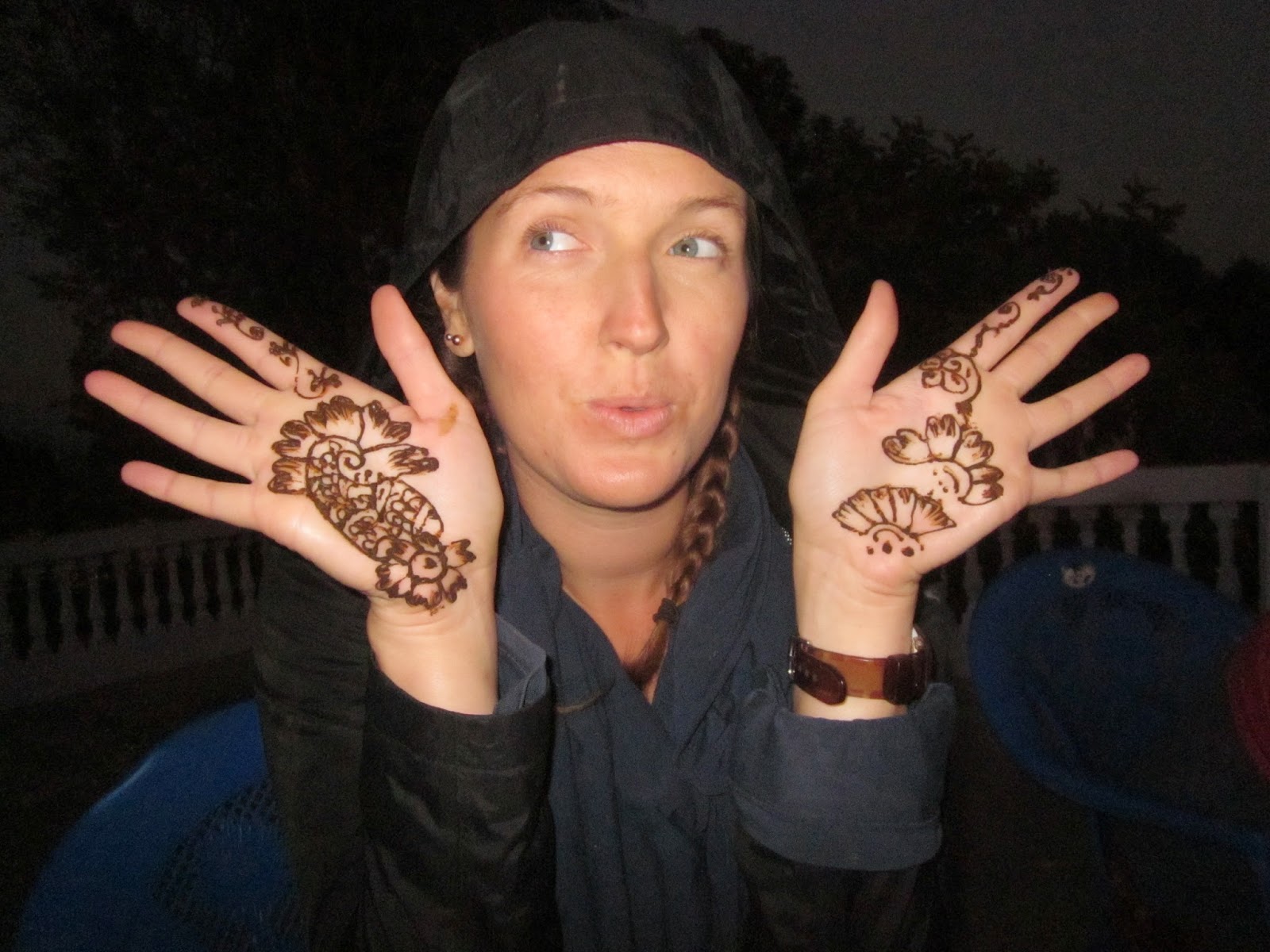
The next week I packed my stuff and took a bus with her cousin to her house.  It was about 6 hours away by bus.  When we arrived, we were greeted with tea and snacks and shown to our room.  Staying at her house was really neat as I got to see all the preparation the day before.  Her family was playing music and putting up decorations as we sat up on the roof and got our hands decorated with mhindi (henna).  
Later that night people began dancing and after little persuasion, I joined the group.  After all, I did bring my light up hula hoop for the occasion!  I enjoyed dancing to the music as it was more similar to club music than the typical Nepali music played in busses, homes, and festivals.  At first I decided to offer the hula hoop to the group to see if they had used a hula hoop before.  Some of them recognized what it was, but did not know what to call it.  After saying “hula hoop” multiple times and getting blank, confused looks they eventually decided to call it a “pipe”.  One gentleman took the “pipe” and spun it wildly above his head as I shielded my eyes and backed away.  A few others were able to spin it a few times around themselves.  Then they offered it to me and I did my usual routine of spins and twirls.  It was great fun and I was asked continuously throughout the night to repeat my performance.  
The next day began with more preparation as different rooms were set up for the occasion.  After my friend was dressed in the traditional attire, she was seated in one of the prayer rooms and her family members came to visit her and wash her feet.  Later, the groom arrived in a car behind a large procession that included a band and about 75 family members. Everyone was dancing as white foam was sprayed into the air landing on everyone like snow.  After the procession, my friend came out of the house and exchanged rings with her new husband.  Then, they parted and more prayer ceremonies commenced.  Finally, the ceremonies ended with the bride and groom sitting outside, physically tied together by a yellow fabric that symbolized their bond.  
It was a very colorful, emotion filled day as the bride does not return to her family’s house after the wedding accept for holidays.  Most marriages in the area where I live are arranged.  Sometimes the bride and groom meet for the first time on the wedding day.  Although my friend’s marriage was arranged, she had met him before hand and had approved the arrangement.  After a few weeks, her husband would leave to Korea for his job.  He plans to be there for 5 years.  My friend said that during that time she plans to still live in my village and work at the Health Post.  Although I am happy that she won’t be moving, I can’t imagine how difficult it will be for her to be away for so long from her husband.  She was happy though and I could tell that she was comfortable with the arrangement.
In the same jovial, parade like fashion that the day started, my friend and her husband drove off in the get away car.  However, unlike American weddings where the bride and groom speed away, the car was slowed to a snail pace once again by surrounding family and friends all dancing and singing. 
“This month is a good month to get married”.  I was told by many people at the wedding.
“Why is that?”  I asked.  “Because of the weather?”
“Yes, that and it’s just a good time.”
“Are you married?”  They ask.
“No.”  I explain.  Expecting the question to pop up at some point.
“People in America usually get married a little later in life.”  

That is usually my way of dodging their concerned looks that I have not been married at this point in life.  It’s a popular topic of conversation and I handle it a little differently every time.  I usually say that after 2 years, when the Peace Corps is over I plan to get married.  Then they smile, and all is well with the world.

Friday, October 31, 2014

“When is Navin (my brother) coming home from Kathmandu?” I asked
“He comes home this Thursday for Tihar.”  My mom replied
“Ok”  I said
“You are going to give him Tikka, OK?” 
“Ok”  I replied.  

Earlier that week our group of Peace Corps volunteers had stayed in Kathmandu 3 days and I was looking forward to coming home and celebrating Tihar with my family.  I prepared for the festival by buying some small gifts and was wondering when the appropriate time would be to offer them.  Like many instances when I am not exactly sure how things will go, I waited to observe what my family would do and decided to follow their lead.  

Tihar is celebrated over 5 days.  The first day is dedicated to worshiping the crow.  The crow is believed to bring people news and because people want it to bring them good news, they offer food to crows on that day.  The second day is dog tikka.  Dogs are believed to be guardians of the underworld, so people show their respect and honor for dogs on that day.  The third day is cow tikka and in the evening Lakshmi puja.  My family doesn’t own a cow, but my friend’s family does and she said that the ceremony involved applying tikka (the red sticky rice) to the cow’s forehead, giving it a necklace of flowers, and sprinkling more rice and flowers on it’s head.  Apparently, its favorite part was the sweet bread it got at the end.  

The evening of the third day was one of my favorite events.  On that night we went around and decorated the house with chains of marigold flowers that we had been making.  Then we lit an altar dedicated to the goddess Lakshmi.  The goddess Lakshmi is believed to bring good fortune, wealth and prosperity to the people in the night and so we lit the path that she takes from the altar to the beds in the house.  The path is first marked with mud, then colored footprints are made that resemble her steps into the house.  Finally, candles are lit and placed along the path.  The windows of the house are left open that night and candles are placed in the windows.  Nepal normally has a policy of scheduled power outages and every day the power goes out for a period of time.  However, during Tihar the power stays on until 9pm so that people can light their lights and invite Lakshmi into the house.

The next day involved lots of cooking and preparation.  We prepared large amounts of sweet flatbread that were distributed around the village.  It was a long process and fun to observe.  In many ways it reminded me of making Christmas cookies.  

On the final day of Tihar, brother’s are honored during bhai Tikka.  The symbolism of the brother Tikka ceremony is reflected in a story about a girl who saved her brother’s life with her love and dedication.  Her brother had fallen ill and was going to be taken by the spirit of the underworld.  She pleaded with the god to spare his life.  The god agreed that he would spare her brother’s life if she took care of him, kept the flowers and plants by his bed fresh and kept the oil on him wet.  She agreed and for a whole year did just that.  The god visited throughout the year and observed her obedience.  At the end of the year, the god was so impressed by her love and devotion that he spared her brother’s life.  It is that love that is celebrated on the final day of Tihar.

  By the last day, my brother was home from Kathmandu and my father’s two older sisters were staying at the house.  At 11am we gathered in the house and I was told to not leave the house until after the ceremony was done.  The door was left open, but no one was allowed to come or go from the house for about an hour while we did bother Tikka.  This Tikka ceremony was different from the one we did for the last festival Dashain.  The Tikka is a series of colors applied to the forehead, with a white circle around it.  It started with my aunt and sisters circling my dad and brother while sprinkling water, then rice water, then oil.  Next, they had oil applied to their heads.  After the oil, my sisters and I placed a row of colors on the forehead of our brother, then had the colors placed on our foreheads.  Finally, we offered gifts of fruit and sweets.  

Overall, Tihar reminded me a lot of Christmas because it involves:

-preparing for the coming of an etherial, gift bearing being in the night by setting out food and lighting lights.
-Decorating the house with colored lights and seasonal flowers.  
-Visiting neighbor’s houses and singing songs.
-Having relatives stay at your house
-Cooking and eating large amounts of sweets
-Giving gifts to family members

Although Tihar is a major festival, it had a more intimate, cozy feeling than the last one.  The house smelled of sweet breads and the colorful lights around the house reminded me of the holidays back home.  I really enjoyed it and am looking forward to my last 2 weeks here.  


Stay tuned because in 2 weeks I will move to the far west district of Nepal.  My house will be a 3 day trip from Kathmandu and 60km from the main road.  I look forward to this adventure as it will be the most remote type of living I have ever done.  Into the future, one step at a time.